All In, Together
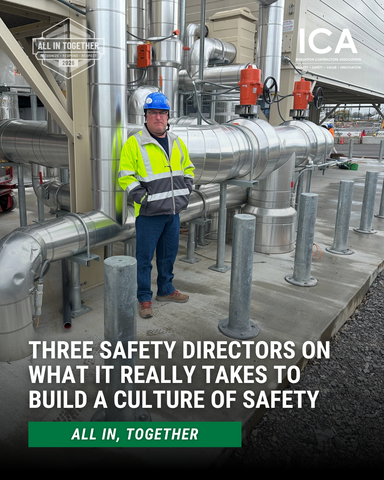
Three Safety Directors on What It Really Takes to Build a Culture of Safety
Construction sites are filled with checklists, regulations, and safety protocols — but the directors who truly move the needle know that safety isn't built on paper; it's built on people. In recognition of Construction Safety Week, we sat down with three safety leaders from the insulation industry to talk about what it really means to be "All In Together" — and how Recognizing hazards, Responding with urgency, and Respecting every worker on the jobsite creates a culture where everyone goes home safe.
The three pillars of Construction Safety Week are: Recognize, Respond, and Respect. We spoke with Pat Conti, Safety Director at Premier Insulation; Mike Picciano, Safety Director at International Asbestos Removal: and Kevin Dalecki, Regional Director for Atlantic Contracting by IREX — three leaders who don't just talk about safety, but have also spent decades trying to improve it.
Pat Conti | Premier Insulation Services Corp · Pillar: Recognize

Pat Conti has been in the insulation trade for 36 years — a career that began, as many do, through family (his father was an insulator). Historically, if you wanted to join union trades, you were placed on a list to become an apprentice. Pat registered for the list, and when his number came up, he decided to give it a shot. Three and a half decades later, he's still a part of Local 12. As a Field Supervisor at Premier Insulation Services Corp, Pat oversees day-to-day operations, manpower, and scheduling — managing crews across renovation, HVAC fitouts, and major projects like the Long Island Railroad and stadium work. He's been with Premier for 16 years and describes quality, production, and safety as inseparable.
Awareness Is Everything
When Pat thinks about recognizing safety on a jobsite, one word comes up immediately: awareness. "Awareness is key," Pat says. "Look around and know your surroundings. If you see something that doesn't look right, stop. Take care of it. Go to the GC. Resolve it — or we won't continue."
Housekeeping is a big part of that for Pat. Don't leave a mess for the next guy. Keep your eyes open. And as he puts it — "eyes behind your head." For Pat, that vigilance extends to equipment: ladders, scissors lifts, tools. Always assume a pipe is hot. Always assume electricity is live. "Assume it'll turn on, and work as safely as possible so you can go home to your family. You can never be too safe.”
No Fear, No Blame
Building a culture where workers speak up starts with removing fear. Pat is direct about it: "Workers are afraid they'll get called out. They shouldn't be fearful to speak up. There's no blame. The littlest minor thing can become huge — so you have to speak up."
When someone flags a hazard, the whole crew benefits. Other trades thank you. You earn respect. And according to Pat, that respect is contagious. "Everyone has each other's back — and hopefully that spreads."
Evolving From Protocol to Trust
Earlier in his career, Pat says safety was all about protocol — checklists, rules, compliance. That foundation still matters, but his approach has evolved. Today, it's about building a crew that thinks on the same wavelength. "I can't be there all the time. If I'm walking away, the crew knows what to do." He took two weeks off and returned to find not a single incident had occurred. That's the standard to which he holds himself..
His advice to newer safety professionals? Don't walk onto a jobsite like you know it all. Listen. Walk the site. Point out the good things — not just the problems. "This is how you earn respect. You're on the same level. You have the same motive: to get the job done and go home safe."
Built to Last
Pat is thinking about retirement in a couple of years — but the culture he's built, he hopes, won't retire with him. "I hope it can run without me. Whoever comes behind me can take the culture we've built and continue on."
For Pat, "built to last" isn't just about safety programs. It's about the product Premier puts out, the relationships they build, and the callbacks they earn because customers trust their work. "You want your product to outlive the job." That same standard applies to safety culture; it shouldn't live on a poster on a wall. It should be lived out, shift after shift, generation after generation.
Mike Picciano | International Asbestos Removal (IAR) · Pillar: Respond

Mike Picciano's path to Safety Director wasn't planned — it was earned. A Local 12 union member, Mike joined IAR in 2000 as an insulator, went through the apprenticeship program, became a journeyman, and worked with his hands for two decades. In 2020, IAR's owners, Karen and Chris, approached him with an opportunity: help build the company's safety program. He accepted the challenge. Six years later, he's the Safety Director — and the reason IAR knew he was right for the job was simple: they wanted someone who knew the field.
"I knew all of the guys by name. I worked side by side with them. They had my respect — and I had theirs." That credibility, earned over 20 years on the tools, is the foundation everything else is built on.
A Healthy Response Starts With Care, Not Blame
When something goes wrong on a jobsite, Mike's first instinct isn't to point fingers. It's to make sure everyone is safe — and then create a learning experience, not a punishable one. "Don't just say 'that was wrong.' Ask: what procedures are in place? Did you follow the PTP? Here's what we can do next time."
An unhealthy response, in his view, looks like the opposite: coming in hot, blaming, threatening suspension or termination. "You lose all respect," he says. And without respect, the whole safety culture crumbles.
“They know I worked in the same field they’re working in now, so they know I know what they’re up against to get the job done,” Mike remarks.
How IAR Handles a Near Miss
Mike walks through IAR's near-miss process with the precision of someone who's refined it over years. First, a verbal toolbox talk the next morning. Then a written, documented discussion. Then it goes to the weekly office meeting with project managers and owners, shared as a learning experience across the organization. Workers get to weigh in: what do they think happened? What would prevent it? A follow-up with the GC comes one to two weeks later.
A key part of the process is letting everyone know it's a shared experience from the field to the administration. The philosophy: safety incidents don't belong to one person… They belong to the team.
Speed Builds Trust
When workers call Mike about an incident, he aims to be on-site within the hour. Not because he's required to, but because he knows what showing up does for trust. "They know that we care. Even GCs have said, 'Wow, you're here already.'"
That responsiveness runs in both directions. Mike brings feedback from the field back to ownership: what workers need, what they're concerned about, what would make them safer. He sees himself as a liaison between the field and the office — and he takes that role seriously. "Even first-year apprentices are encouraged to speak up about safety. If you could save a life, it doesn't matter who you are."
Built to Last
At IAR, Mike's approach to lasting safety culture comes down to consistency and relevance. Weekly toolbox talks are tailored to specific jobs the crew is working on that week — not generic jobsite discussions. Regular field audits let him personally observe how teams are working rather than just relying on verbal feedback.
Mike certifies every IAR worker to operate lifts, with each worker receiving their own harness, fitted to their body. IAR invested in Type 2 hard hats — with chin straps and impact grading — for the entire company.
Thanks to Mike’s training, the crews know that when they prepare for new projects, they bring their entire tool kit, including their safety equipment. It’s ingrained into their culture. Full protection is a part of their daily tools, and it has become a common practice. Mike’s mantra is “Be consistent in something,” and IAR’s crews live that out in their safety culture.
“When you keep doing the same thing day in and day out, it sinks in,” Mike shares.
For Mike, that's what “built to last” really means: not a program, but a practice, and one that becomes as natural as picking up your tools at the start of a shift.
Kevin Dalecki | IREX Atlantic Contracting · Pillar: Respect

Kevin Dalecki has been with IREX for 35 years — and like Pat and Mike, he came up through the trades. He started as a carpenter in the field at Irex. A safety incident at the company early in his career led to a turning point: the company would pay for him to go to school if he was willing to embrace safety culture. He took them up on it. Decades later, he's Regional Director for Atlantic Contracting by IREX — and he's helped build a safety culture that includes everyone from truck drivers to the president of the company.
"I never thought I'd make it to where I am," he says. "I made a career out of it."
Respect Starts With Listening
For Kevin, respect in construction safety means respecting the hazards, the people, and everyone's role on the jobsite. But it goes beyond the philosophical; it's operational. Before creating safety policies, Kevin requests input from the field. Atlantic's Good Catch program is a notable example: workers submit identified hazards, the best ones are reviewed each month, and winners receive gift cards — with the top catch of the year earning an 80-inch TV. "They bring things to our attention because we aren't always on the jobsite."
Kevin trained everyone — from truck drivers to the company president — in an eight-hour safety session just weeks ago. "When you have the president of the company sitting in an eight-hour training session, it means something. They're all participating. That's a good thing."
No One Left Behind — Including Language Barriers
Atlantic's workforce is diverse — and Kevin has gone the extra mile to make sure safety communication reaches everyone. Orientation videos are available in multiple languages, paperwork is professionally translated, bilingual team members help bridge gaps in real time, Google Translate fills in where needed. "We're learning to find ways to communicate clearly."
Every worker goes through orientation as part of the safety team. Managers conduct four site inspections a month and walk alongside field crews — not above them. "It's a team approach."
Delivering Hard Feedback With Dignity
Kevin is thoughtful about how correction happens on a jobsite. Not hollering or belittling, but instead, engaging workers, getting the point across and showing why safety matters. He's seen workers go through drug and alcohol programs, face serious personal challenges — and come out the other side as some of the best foremen and leaders in the field. "A lot of these guys don't like schoolwork. They like using their hands. And every time I'm around them, I learn something too."
Built to Last
Kevin has watched Atlantic's safety culture transform over 35 years — and he's measured its growth in buy-in. Early on, there was pushback on safety costs. Now? None. Managers who once needed convincing are now champions. Workers tell him: "We like working for Atlantic — you give us proper equipment. If we need something, you provide it." Other trades don't always offer that, but Atlantic does.
The safety culture is reinforced through procedures, training, group sessions, and leadership modeling. Defensive driving techniques learned on a jobsite go home with workers — safety beyond the jobsite. And Kevin is already thinking about succession. He's currently mentoring an insulator with the right personality, the right knowledge, and field experience who could one day step into his role.
“I see where we were and where we came from. Watching the buy-in grow over the years - it’s a positive thing,” Kevin said. He has also been an integral part of its growth at Irex.
"Reinvesting in the next generation of safety directors." That, for Kevin, is what “built to last” really looks like.
All In, Together
Recognize. Respond. Respect. Three words. Three leaders. One shared resolution: that safety is never just a program — it's a promise made to every person who shows up to work.
Pat Conti, Mike Picciano, and Kevin Dalecki didn't develop their safety philosophies through a certification course or a corporate mandate. Their individual and collective commitment to safety is the result of decades of showing up — to the field, to the crew, to the hard conversations and the close calls. They know that the strongest structures we build aren't made of steel and concrete; they’re made of trust, accountability, and the belief that we're all in this together.
This Construction Safety Week and Building Safety Month, we're proud to celebrate leaders who are building safety cultures that are truly built to last.