THE CRITICAL IMPORTANCE OF FIRESTOPPING IN NEW YORK CITY'S BUILT ENVIRONMENT
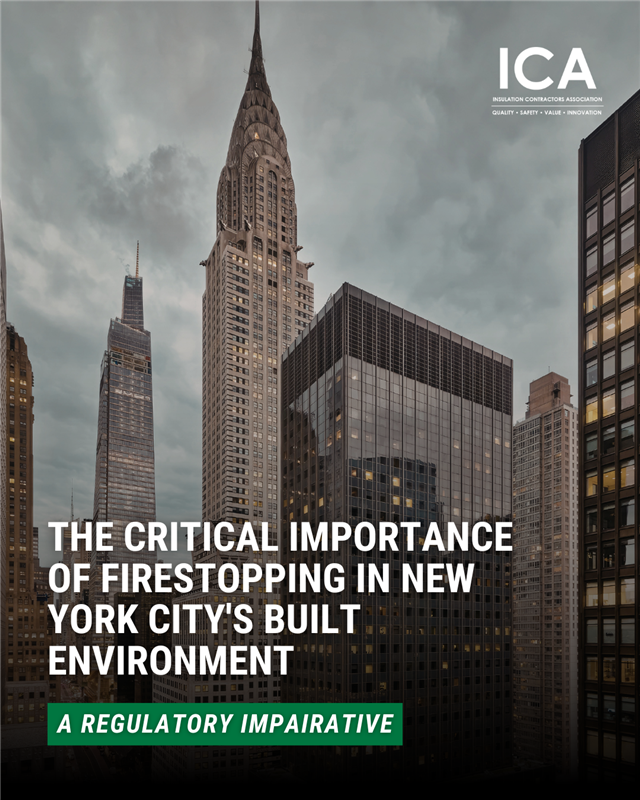
In a city defined by density and vertical ambition, firestopping is not a finishing detail — it is a foundational discipline that separates compliant construction from catastrophic risk.
New York City's skyline is a testament to engineering ambition. Yet within the walls, floors, and ceilings of every high-rise, hospital, government building, and commercial tower lies a system of passive fire protection that most building occupants will never see and rarely consider — until it is needed most. Firestopping, the practice of sealing penetrations and joints in fire-rated assemblies, represents one of the most consequential — and frequently underestimated — components of the modern built environment.
At its core, firestopping addresses a complex issue that has profound implications on building safety. Every building contains countless penetrations: conduits, pipes, ducts, and cable trays that pass through fire-rated walls, floors, and ceilings. Without deliberate intervention, these openings become pathways through which flames, heat, and toxic smoke can travel with alarming speed, bypassing the very barriers designed to contain a fire and protect occupants. Firestopping materials — including intumescent sealants, fire-rated mortars, wraps, and collars — are engineered to seal these openings and restore the fire-resistance rating of each assembly to its original specification.
A REGULATORY IMPERATIVE IN NEW YORK CITY
The regulatory landscape governing firestopping in New York City is among the most rigorous in the nation. The New York City Building Code, alongside the New York State Uniform Fire Prevention and Building Code, mandates firestopping across commercial, residential, and industrial construction. In 2014, the NYC Department of Buildings adopted firestop special inspection requirements aligned with two ASTM standards — E-2174 for penetrations and E-2393 for construction joints — requiring independent, third-party inspection of all firestop systems before they are concealed from view.
Firestopping is a critical area of fire protection in commercial buildings to limit the spread of building fires — and the importance of independent inspection cannot be overstated.
These requirements reflect a hard-won understanding: firestopping is only as effective as its installation. Improperly applied materials, misidentified penetration types, or the use of non-listed products can render an entire fire-rated assembly ineffective. The ASTM inspection standards were designed precisely to address this vulnerability, ensuring that inspectors remain independent of the installer and that documentation is thorough enough to support both regulatory review and insurance verification.
WHO DEPENDS ON FIRESTOPPING?
The demand for expert firestopping spans virtually every sector of New York's built environment. Hospitals and healthcare facilities require uncompromising fire barrier integrity to protect vulnerable patients and critical infrastructure. Schools, universities, and government buildings carry a public trust that leaves no margin for error. High-rise office towers, airports, and port authority facilities face unique challenges of scale and complexity, where a single compromised penetration can have consequences far beyond a single floor or zone. Whether a project is publicly funded or privately developed, the standard of care — and the professional obligation — remains the same.
ICA MEMBERS LEADING BY EXAMPLE
ICA contractors are acutely aware of the importance of firestopping. The caliber of work carried out under the ICA banner is perhaps best illustrated by the landmark projects ICA member contractors have delivered across the metropolitan region. IAR (International Asbestos Removal), a certified Women's Business Enterprise with roots in the industry stretching back more than six decades, has completed firestopping and insulation work at every major New York airport, iconic arenas, power plants, and hospitals — including the New York-Presbyterian David H. Koch Center. Their installers hold certifications from 3M, Hilti, and Specified Technologies Inc., and IAR is a proud member of the Firestop Contractors International Association (FCIA).
Atlantic Contracting & Specialties, the New York arm of the Irex Contracting Group, brings more than fifty years of service-oriented performance to projects of the highest complexity. Among their notable New York projects is One Bryant Park, the 56-story LEED-certified tower that stands as one of the most sustainable skyscrapers in the country. Atlantic installs UL-classified and FM-approved firestop systems across the full range of penetration types — from metallic and plastic piping to cable trays, curtain wall assemblies, and insulated ductwork.
X-Cell Insulation, a family-owned firestop specialty contractor based in Bohemia, New York, brings a distinctly technology-forward approach to life safety. Specializing in healthcare and education — with clients including NYU Hospital, Northwell Hospital, and the U.S. Tennis Association — X-Cell has developed DocuLife Safety, a proprietary fire barrier management system that enables building owners and facility managers to identify, track, and manage critical fire protection infrastructure across their properties. Designed to provide long-term visibility into the condition of a building's firestop systems, DocuLife Safety represents precisely the kind of innovation that raises the standard of care across the industry. X-Cell also offers long-term maintenance agreements, ensuring that life safety systems remain current and code-compliant well beyond initial installation.
Across the ICA membership, contractors bring the same depth of certification, documentation discipline, and trade coordination to every project — whether it is a new hospital wing in the Bronx, a government facility in lower Manhattan, or a school renovation on Long Island.
THE ICA'S ROLE IN UPHOLDING STANDARDS
Member contractors of the Insulation Contractors Association of New York City bring certified expertise and professional accountability to every firestopping project. ICA members routinely collaborate with architects, engineers, and property managers to assess building penetrations, select appropriate UL-listed systems, and deliver complete project documentation. This collaborative approach is particularly vital in New York City's complex construction environment, where the density of mechanical, electrical, and plumbing trades creates an extraordinary volume of fire-rated penetrations on any given project.
The consequences of inadequate firestopping extend beyond regulatory non-compliance. Property owners who cannot demonstrate proper firestop installation may face complications with insurers, heightened liability exposure in the event of a fire, and potential enforcement action by the Department of Buildings. Conversely, buildings with rigorously installed and documented firestop systems offer their occupants, insurers, and investors a measurable and meaningful layer of protection.
SPRING: THE IDEAL SEASON FOR FIRESTOP INSPECTIONS
As the building industry enters its most active season, spring represents an opportune — and often overlooked — moment for building owners and facility managers to assess the condition of their firestop systems. The winter months subject a building's envelope and mechanical systems to significant stress: thermal cycling causes materials to expand and contract, sealants can degrade or crack, and maintenance work performed over the colder months may have introduced new penetrations that were never properly sealed. By the time spring arrives, a building's firestop systems may be meaningfully different from what was originally inspected and documented.
A professional firestop inspection conducted in the spring can identify these vulnerabilities before they become liabilities. Qualified ICA contractors are equipped to survey a building's walls, floors, and ceiling assemblies systematically — cataloguing penetrations, evaluating the condition of existing sealants and collars, identifying unpermitted or unsealed openings introduced during renovation or maintenance activity, and assessing whether installed systems remain in conformance with their original UL-listed specifications. The result is a detailed inspection report that serves multiple purposes: it informs remediation priorities, satisfies insurance documentation requirements, and provides building owners with defensible evidence of due diligence in the event of an incident or regulatory audit.
For owners of older buildings in particular — where firestopping may have been installed under previous code regimes, or where decades of tenant improvements have compromised original assemblies — a spring inspection is not merely advisable. It is an essential component of responsible building stewardship. The earlier deficiencies are identified, the more cost-effective the remediation and the lower the risk to occupants and property alike.
LOOKING AHEAD
As New York City continues to evolve — through new construction, adaptive reuse, and the retrofitting of aging building stock — firestopping will remain an area of increasing scrutiny and sophistication. Advances in intumescent technology, the growing complexity of building systems, and an ever-tightening regulatory environment demand contractors who are not merely familiar with firestopping, but genuinely expert in it. The ICA of New York remains committed to education, training, and the elevation of industry standards to ensure that every building in the New York metropolitan region is as safe as the craftsmanship within its walls demands.
For building owners, developers, and project managers, the message is clear: firestopping is not an afterthought. It is a discipline — and one that deserves the attention of the most qualified professionals in the field. This spring, take the first step.
TAKE ACTION THIS SPRING
IS YOUR BUILDING'S FIRESTOPPING UP TO STANDARD?
A professional firestop inspection can identify vulnerabilities before they become liabilities — and connect you with the documentation your insurers, regulators, and occupants depend on. ICA member contractors are certified, experienced, and ready to assess your building this season.
NEXT STEPS:
1. Assess your risk.
Consider when your building's firestop systems were last inspected, and whether any renovation or maintenance work may have introduced new, unsealed penetrations.
2. Schedule an inspection.
Engage a certified ICA contractor to conduct a systematic survey of your fire-rated walls, floors, and ceiling assemblies and produce a full inspection report.
3. Find the right contractor.
Browse the ICA of New York's member directory to connect with qualified firestopping professionals serving the greater New York metropolitan region.
Find an ICA Contractor Near You:
https://www.icanyc.org/Members/Search.aspx