The Energy Savings Hiding in Plain Sight
How mechanical insulation supports green building and energy conservation.
When people talk about green buildings, the conversation usually turns to solar panels, high-performance windows, and electrification. Those all matter. But one of the most effective energy conservation measures in any building is already wrapped around its pipes, ducts, and equipment.
Mechanical insulation rarely makes headlines. It sits behind ceilings, inside mechanical rooms, and along miles of piping that most building occupants never see. Yet it does essential work every hour of every day, and when it is missing or damaged, energy is lost just as quietly.
Energy Awareness Month, observed every October, is a good reminder to take a closer look at how buildings use and conserve energy. For ICA contractors and the skilled union workforce behind them, that conversation leads straight to insulation, where the trade makes one of its biggest contributions to a more sustainable New York.
The Overlooked Efficiency Measure
A building's mechanical systems move enormous amounts of energy: steam and hot water for heating, chilled water for cooling, conditioned air through ductwork, and process piping in industrial and institutional facilities. Every uninsulated or under-insulated surface along the way loses heat or gains it, forcing boilers, chillers, and air handlers to work harder to make up the difference.
Properly specified and installed mechanical insulation addresses that loss directly. It also delivers benefits that go beyond the energy bill:
- Lower energy use and emissions. Less wasted heat means less fuel burned and less electricity consumed.
- Condensation and moisture control. On chilled water and refrigerant lines, insulation with an intact vapor retarder prevents condensation that can lead to corrosion, mold, and water damage.
- Equipment protection. Systems that are not fighting constant heat loss or gain run more efficiently and can last longer.
- Personnel protection. Insulation keeps hot surfaces at safe temperatures for the people who work around them.
- Process control. In hospitals, labs, and industrial settings, insulation helps maintain the temperatures that critical systems depend on.
Unlike many green building upgrades, mechanical insulation does not require new technology or a major redesign. It is a proven, practical measure, and its effectiveness depends on the quality of the installation.
Why It Matters More Than Ever in New York
New York City has some of the most demanding building energy requirements in the country. Under Local Law 97, most buildings over 25,000 square feet must meet greenhouse gas emissions limits that began in 2024 and become significantly stricter in 2030. The city's goal is to cut emissions from its largest buildings 40 percent by 2030 and reach net zero by 2050. Buildings that exceed their limits face annual penalties for every metric ton over the cap.
Insulation is written directly into the law. For buildings on Local Law 97's prescriptive pathway (Article 321), the required energy conservation measures include insulating all pipes for heating and hot water and insulating steam condensate or water tanks. That is a clear signal of how the city views insulation: not as an optional upgrade, but as a baseline measure for an efficient building.
For new construction and major alterations, the New York City Energy Conservation Code sets minimum insulation requirements for piping and ductwork. Meeting the code on paper is only the start. Real-world performance depends on insulation being installed to spec, sealed correctly, and kept intact for the life of the system.
As owners look ahead to the 2030 limits, many will focus on large capital projects like electrification and equipment replacement. Insulation upgrades belong in that conversation too. They are comparatively low cost, quick to complete, and they make every other system in the building more efficient, including new electric equipment.
The Quiet Energy Drain: Missing and Damaged Insulation
In many existing buildings, the biggest energy losses are not in the systems themselves but in the gaps. Valves, fittings, flanges, and strainers are often left bare because they are harder to insulate or because insulation was removed for maintenance and never replaced. Insulation that has been crushed, soaked, or torn by other trades loses much of its effectiveness without anyone noticing.
These problems are easy to overlook because they rarely cause an immediate failure. Instead, they waste energy every day, year after year.
An insulation appraisal or audit is one of the simplest ways for an owner to find these losses. A qualified contractor can walk the mechanical spaces, identify missing and damaged insulation, and help prioritize repairs based on system temperature and run time. For buildings working toward Local Law 97 compliance, it is a practical first step with a measurable payoff.
Energy Conservation Starts in the Field
The energy performance of an insulation system is decided on the job site. A few practices make the difference between insulation that performs for decades and insulation that underdelivers from day one:
- Install to the specified thickness and material. Substitutions and shortcuts reduce performance and can put a project out of code compliance.
- Seal vapor retarders completely on cold systems. A single open seam or puncture lets moisture in, and wet insulation loses its insulating value.
- Don't skip the hard-to-reach components. Valves, fittings, and flanges should be covered, using removable insulation covers where regular access is needed.
- Replace what gets removed. When insulation comes off for maintenance or repairs, make sure it goes back on, or flag it for replacement.
- Protect finished work. Coordinate with other trades so completed insulation isn't damaged by later work.
- Document the work. Clear records support code compliance, Local Law 97 reporting, and future maintenance.
These habits are part of what sets a trained, professional workforce apart, and they are where energy conservation happens in practice.
Where Firestopping Fits
Many ICA members also install firestop systems, and that work connects to building performance as well. Firestopping is first and foremost a life safety measure, sealing penetrations in fire-rated walls and floors to slow the spread of fire and smoke. Properly sealed penetrations also limit uncontrolled air movement between spaces.
Keeping those systems effective over the life of a building takes ongoing attention. ICA member X-Cell Insulation, for example, developed DocuLife Safety, a fire barrier management system that helps building owners and facility managers track the condition of firestop systems across their properties over time.
The common thread is quality installation. Whether it is a firestop system or a run of insulated pipe, performance depends on certified installers, the right materials, and careful documentation.
ICA Members Leading the Way
ICA member contractors have contributed to some of New York's most recognized sustainable buildings. Atlantic Contracting & Specialties, for example, worked on One Bryant Park, the 56-story LEED-certified tower that is regarded as one of the most sustainable skyscrapers in the country.
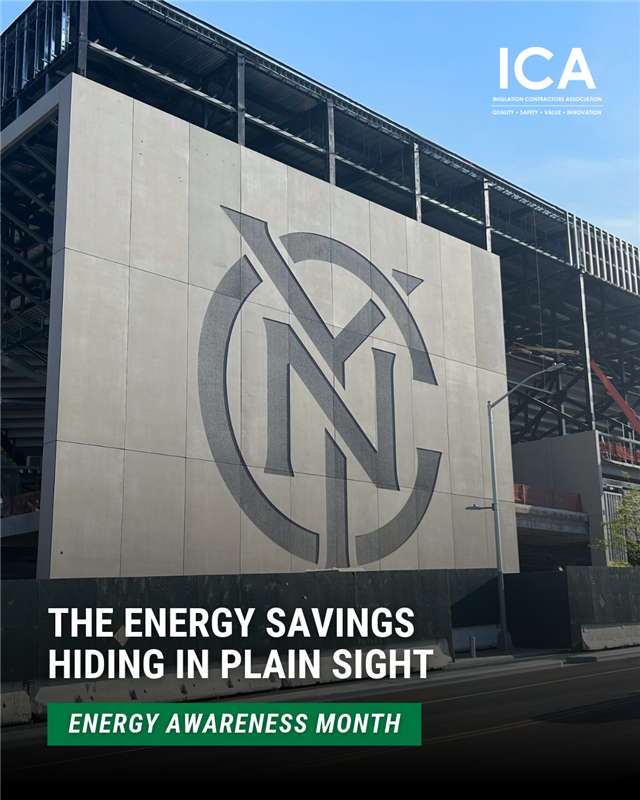
That work continues today. IAR, a certified Women's Business Enterprise, is insulating the HVAC ductwork, mechanical piping, and plumbing systems at Etihad Park, the new home of New York City FC in Queens. With the stadium targeting LEED Gold certification, energy efficiency is a priority throughout its design and construction. Much of IAR's work will be concealed behind walls and ceilings, but it will play a lasting role in the building's energy performance.
Behind that work is a skilled union workforce trained to install insulation systems the right way. Apprenticeship and ongoing training keep installers current on materials, codes, and best practices, which is exactly what high-performance buildings require.
For owners, construction managers, and partners, the takeaway is simple: some of the most reliable energy savings in a building are hiding in plain sight, and ICA contractors are ready to help find them.
Sources